Monkey See, Monkey Do! – Role Modelling and Children’s Eating
I once ate a child’s lunch while doing a casual shift in a daycare. Before you judge me, I had a good reason to do that, so hear my story (and only then, judge me!)…
This boy used to refuse any food that wasn’t very sweet or very salty – think snack bars and chips. Everyday, his lunchbox had, amongst the discretionary foods, a small tin of tuna and a small container with cooked rice which were never offered to him by the educators who would make him a Vegemite sandwich in replacement for lunch.
When I asked why he wasn’t served the food that looked like was sent for his lunch (tuna and rice), the room leader said that he didn’t like it as they had tried once and he refused, so they ‘avoided waste’ by giving him a sandwich instead.
If you’re a regular reader of this website’s content, you may know what’s wrong with this practice, but I’ll describe it once again…
I argued that that boy was just one-year-old and his taste for foods was just in its first stages of development, that he would need many opportunities to learn how to handle new tastes, textures, smells which means repeated offerings of the same foods etc etc
The puzzled look on the faces of the room leader and the other educators told me they had no idea of what I was talking about and I new I’d need a lot more time to explain. So, I decided to do something else instead – yeah, I HAD to do something!
I asked permission to, instead of making him another Vegemite sandwich, offer rice and tuna from his lunchbox. They told me “Good luck!”. So, I warmed up a little bowl with it, but ALSO made a second little bowl for myself.
I placed his bowl in front of him which he pushed away, frowning. I then sat down next to him and started eating mine. I didn’t say anything and barely looked at him, but, from the corner of my eye, I could see him watching me.
After 30 seconds or so, he took his bowl and put a spoonful in his mouth!!! Frowned, but took a second one!!!!! The other educators couldn’t believe their eyes, neither could I… Anyway, he didn’t eat the whole portion, but he tried it. And I believe it was the very first time he did. And I also believe that he had never seen anyone eating tuna. So, he may not had known it was even food!
Role Modelling
The first years of life is the time when habits are acquired and consolidated, including eating habits and food choices (1). Role modelling is children’s best source of information. They watch and mimic the adults they trust and respect. So, what we do and don’t do with food around them shapes their own eating behaviour.
In April, the Australian Bureau of Statistics (ABS) released a report on the population’s apparent consumption of foods. ‘Apparent consumption’ means the purchase of foods in retail stores (e.g. supermarkets, butchers, bakeries etc) and doesn’t include takeaways, restaurant, home-grown etc.
One piece of information of that report is the consistently lower than the recommended consumption of all core food groups between 2018-19 and 2022-23 (2). See chart below.
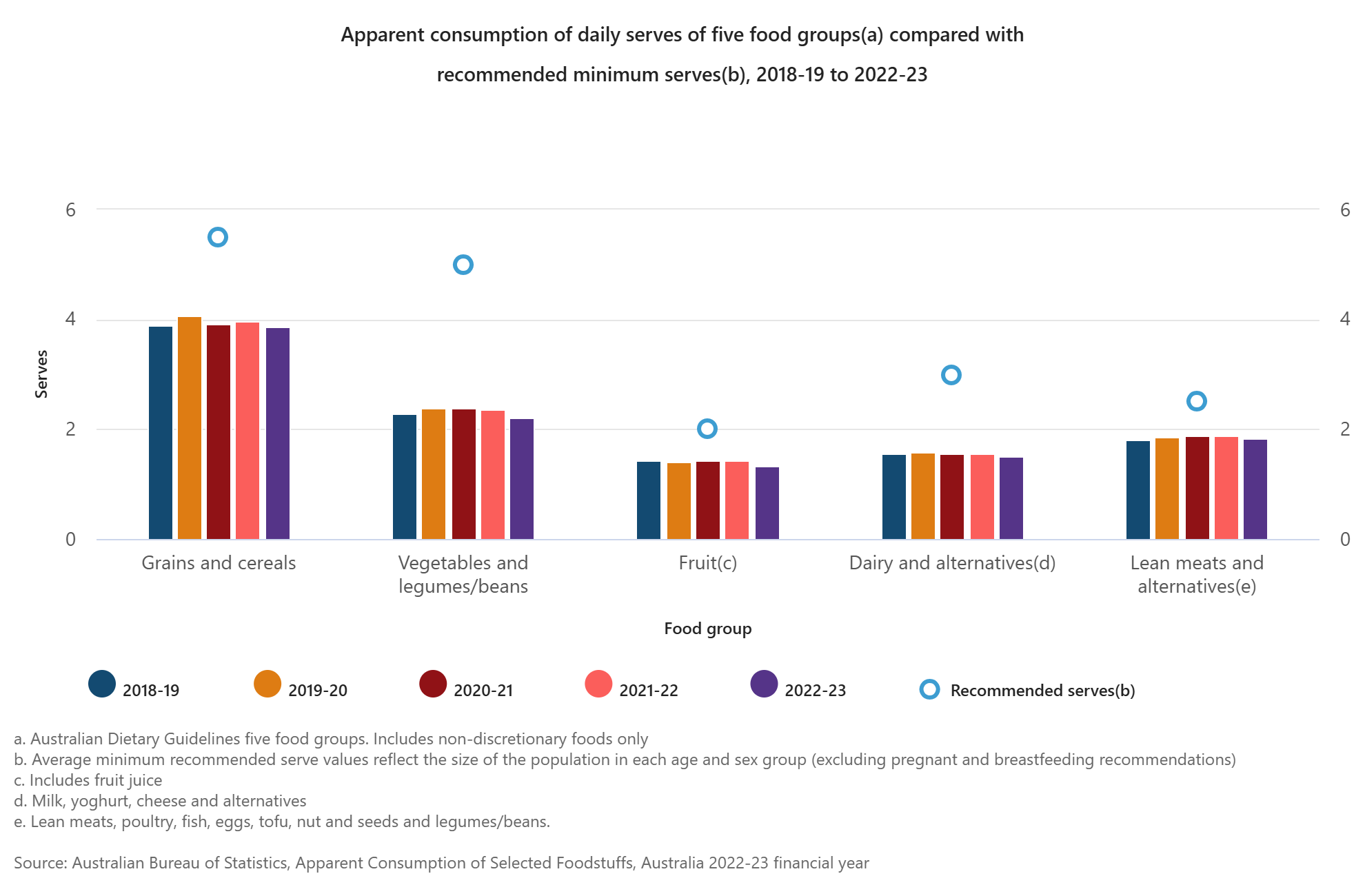
Adult Australians are far from eating the recommended amounts of all core food groups.
So, I ask: How can we ask children to eat their veggies if WE are not eating ours?
Why would they eat something they never saw their mum and dad or their teacher eating? “It must taste terrible if they don’t eat it themselves!” – I think it’s a pretty fair argument, right?
I once worked with a family to improve dinner times with their six-year-old fussy eater. The mother was particularly worried about him not eating fruit at all. After about five months working together, the boy was already enjoying some fruit in his diet, I find out that THE MOTHER never ate a piece of fruit in her life! I, of course, didn’t judge and supported her in changing the son’s eating pattern. I totally understand her concerns and even feelings of guilt for the son not being at all interested in eating fruit.
My point here is that, children will very likely stick to the eating pattern their trusted adults show. If we eat the stuff we want the children to eat, they will eventually get into it.
It’s not a sophisticated strategy, it’s not rocket-science and it’s very easy: simply sit next to your child and enjoy a meal together – just three times in a week can make a big difference to children’s eating and general health (3, 4).
Read more about the benefits of family meals in 3 Things to Try Tonight at Dinner.
References
(1) Influencing Children's Eating Behaviours. (Study, 2018, Italy)
(2) Apparent Consumption of Selected Foodstuffs, Australia – Australian Bureau of Statistics. (2024)
(3) Is Frequency of Shared Family Meals Related to the Nutritional Health of Children and Adolescents? (Study, 2011, USA)
(4) Family meals can help children reach their 5 A Day: a cross-sectional survey of children's dietary intake from London primary schools. (Study, 2013, UK)