Non-Feeding Food Exposure (part 2)
Children are amazing creatures who are ALWAYS ready to learn something! They are tuned in and alert almost hundred per cent of their awake time, since the minute they are born, about things going on in the surroundings.
We must remember this as we go about our day around them. And, whenever possible create or enhance their opportunities for learning. Here, I’ll focus on eating, of course.
In my previous article, I mentioned that we have to learn how to eat. We learn how to eat by observing the adults we trust doing it and by exercising, exploring, experimenting with foods and our senses. And if we manage to allow children these experiences without pressure, in a relaxed way, the chances of them learning quickly and developing taste for foods - including those you want them to eat - increase.
A great way of providing these pressure-free opportunities is food related activities away from the table, when there’s no expectation to eat.
Think…
Sensory Play
Even though children will use their senses (vision, smell, taste, hearing and touch) to explore foods in any type of exposure, I’ll describe a few activities that are more focused on one or two senses at a time:
Home-made play dough is a good one. You can make it together with your child or not. In the daycare where I do casual work, we usually make it with the children. You can add texture to the dough. Things like rolled oats or shredded desiccated coconut. You can also add food colourings for a different colour every time. Add flavourings such vanilla extract. There you have play time with food exposure without a hint of pressure to eat it!!
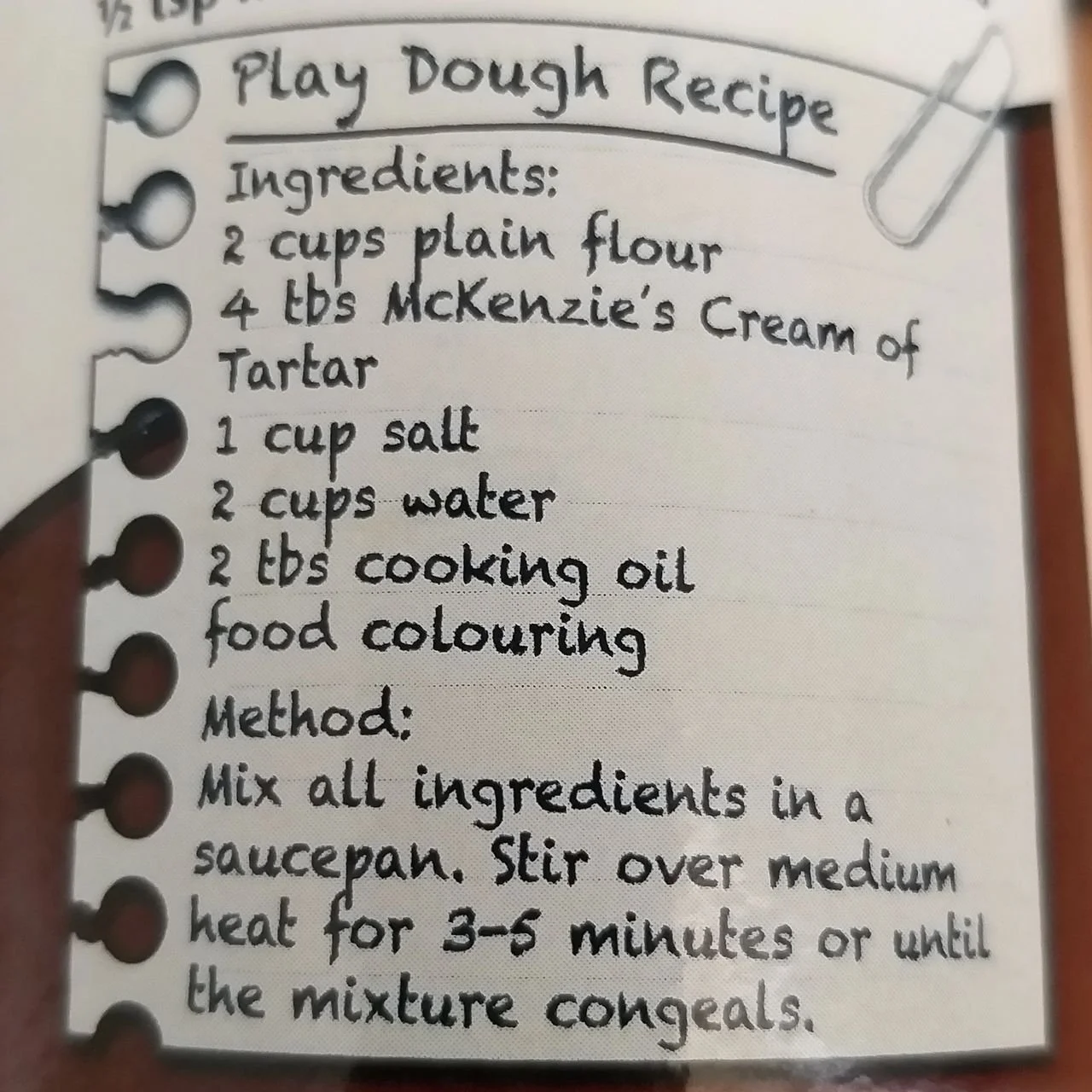
McKenzie's cream of tartar package recipe
I use the recipe in the image, but use lukewarm water and then mix it in a bowl, without any extra heating. It usually turns out really good.
Another one I like a lot is to place a known fruit or vegetable in a bag that children can’t see through and let them - one at a time, if you have more than one child participating - stick their hands inside to touch the food to try guess what it is. This one is super easy, doesn’t waste any food and can be used as a follow up after reading a book featuring that particular fruit or vegetable, or simply after an occasional conversation.
And then there’s handling foods at mealtimes which is great particularly for babies. For example, letting them dip their fingers, smear, rub foods like hummus, peanut butter, mashed potato, yoghurt etc. Or tear/break biscuits, bread, meat etc. This you can also provide away from mealtimes.
Now, if you’re like me, you may worry about food waste, so just follow your gut. If you notice they are exploring the food (playing with it) more than actually eating, and you think it’s going too far and wasting too much food, take it away for another try (to eat) later. Just keep in mind that it’s part of the process, and once they are done with the exploration and start eating it, there won’t be as much waste anymore. 😉
Drama (pretend play)
Children have the chance to exercise real life while pretending to doing things grown-ups do. Things like cooking, shopping, going to work as a doctor, as a fire fighter, as a mechanic etc.
These occasions help them think about what it would be in real life. That’s when pretend play with pretend foods can come in handy.
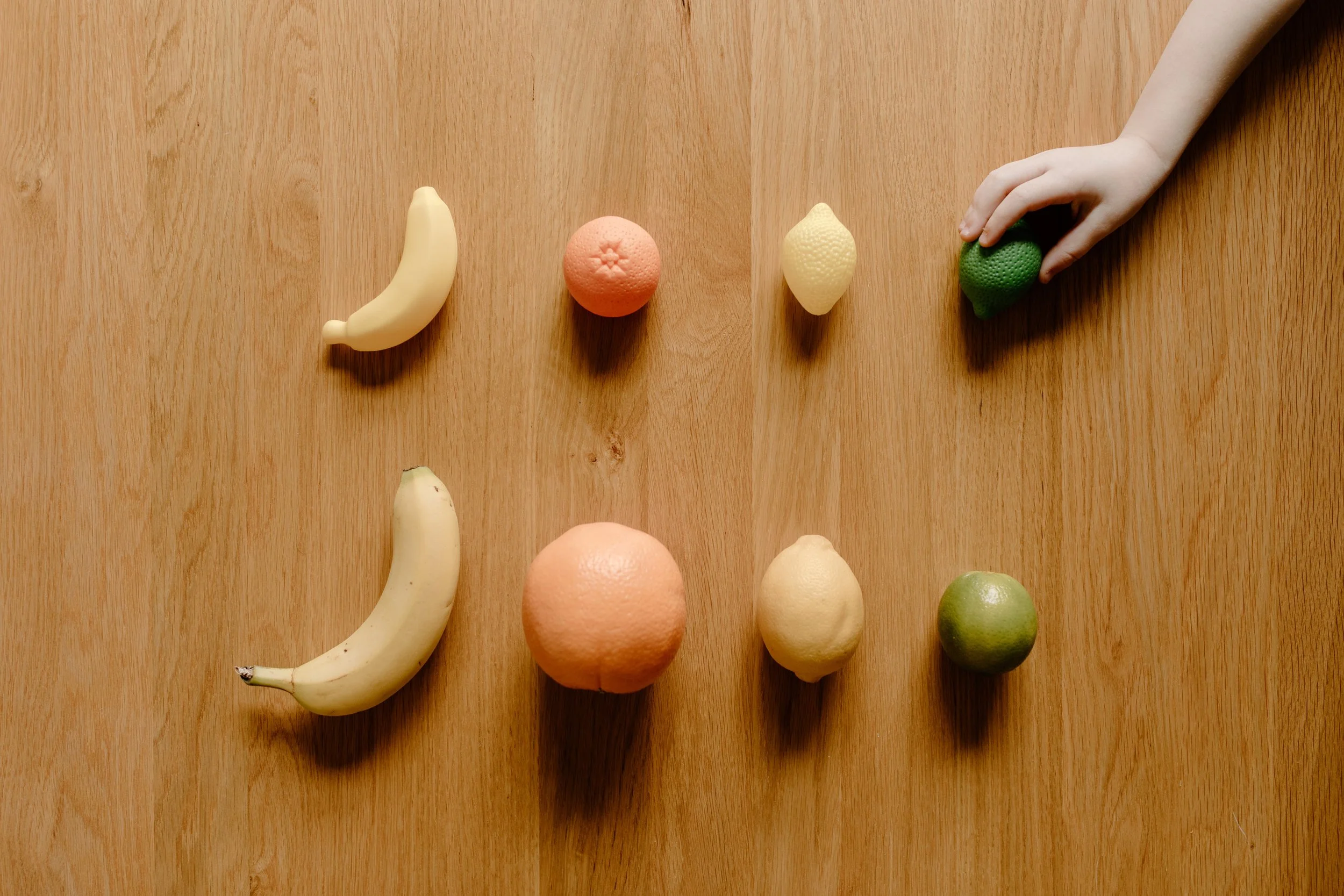
Children can be provided with toy foods, cut-outs from magazines and catalogues, imaginary foods (a wooden block for a bread roll, for example). The activity can be guided by an adult or not.
The idea is to let children have contact and explore some characteristics foods present. Things like shape, colour, name, varieties etc.
The more children learn about a specific food they don’t yet eat, the more confident they will feel to try it when offered.

Image by Kampus Production on Pexels.
Gardening
Growing foods is described as a powerful experience even for adults. It certainly is for me! 😊 Children too display a beautiful amazement when they see sprouts of the seeds they dipped in the dirt.
Providing children with the opportunity to learn many aspects of foods growing in front of their eyes is strongly linked with their acceptance of fruit and vegetables on their plate.
By the end of 2020’s financial year, Stephanie Alexander Kitchen Garden Foundation had trained more than fifteen thousand professionals - mostly educators - at 1495 schools and other children’s services around Australia. Sixty-five per cent of the Foundation’s income came from corporate institutions. I think these numbers say something about how relevant the topic is regarded in this country, and believe it’s not too different in other countries.
If your child is lucky enough to attend a school or a daycare or a play group that use gardening as an educational activity, celebrate and take advantage of it by showing interest and even participating in the activities. If your child doesn’t attend a service that provides such activities, you can provide it yourself at home. Start small, with a couple of seedlings you can buy at your local nursery or supermarket.

Most children will enjoy helping in the garden.
There is a myriad of activities where food education can be incorporated. I’ll list below the ones Dazeley & Houston-Price used with 92 children aged one to three years of six daycares in the UK. Their results showed that hands-on activities with unfamiliar fruits and vegetables can enhance children’s willingness to taste these foods, and confirm the potential for such activities to support healthy eating initiatives:
Compare a whole food’s inside with the outside.
Find items around the nursery that match the colour of each given food.
Draw a picture of a food.
Sing a nursery rhyme about fruit and vegetables (they adapted Old McDonald Had a Farm).
Run toward a picture of a food when its name is called.
Listen to the noise made when the food is snapped or squeezed. – I love this one!! 😊
Feel the texture of the outside of whole foods then the inside too.
Compare the texture of chopped-up foods before and after they have been cooked.
Listen to a story about a child smelling foods in the shop and at home, smelling the foods while listening to the story.
Smell cooked foods.
Compare the smells of cooked and uncooked foods.
Want more? Karen Le Billon came up with 20 games in her book The Seven Secrets of Raising Happy Eaters, released in 2014. Warning: some of the games involve “tasting”, not exactly eating, but putting foods in mouths.
My intention with this article, both parts, was to make sure you’re aware of more ways of encouraging your children to enjoy foods, not only at mealtimes. Many of the activities I mentioned here can be done without much planning or preparation. It’s more a question of taking opportunities for them to happen. Be assured that the little extra effort is totally worth it.
References
Exposure to foods’ non-taste sensory properties. A nursery intervention to increase children’s willingness to try fruit and vegetables (Study, 2014, UK/Malaysia).
VeggieSense: A non-taste multisensory exposure technique for increasing vegetable acceptance in young children (Study, 2021, UK). https://pubmed.ncbi.nlm.nih.gov/34748876/
Garden-Based Integrated Intervention for Improving Children’s Eating Behavior for Vegetables (Study, 2020, Korea). https://www.ncbi.nlm.nih.gov/pmc/articles/PMC7068610/
Increasing Fruit and Vegetable Intake among Children and Youth through Gardening-Based Interventions: A Systematic Review (Study, 2017). https://pubmed.ncbi.nlm.nih.gov/27964852/
Changing children's eating behaviour - A review of experimental research (Study, 2017, Denmark). https://pubmed.ncbi.nlm.nih.gov/28286164/
Stephanie Alexander Kitchen Garden Foundation Annual Report 2019-2020.
The Seven Secrets of Raising Happy Eaters/Getting to Yum (Book, 2014, USA).