Snack: a Dirty Word?
A few weeks ago, it felt quite disconcerting going through the list of products that resulted of a search I did for KIDS & LUNCHBOX SNACK on a major supermarket online shop: crisps, protein bars (!!!), chocolate bar, chocolate candy, chocolate coated nuts, dried fruit, more chocolate bar, bliss balls (coated in chocolate), cheese slices, cheese sticks, creamy cheese, crackers, raisin toast, cheese cubes, more chocolate candy…
Then, out of curiosity, I googled the word SNACK. My-oh-my… the results list wasn’t very different from the supermarket one: crisps, chips, cookies, crackers, popcorn…
I’m sure you looked at the lists above and mentally classified each product as “healthy” or “unhealthy”… hmmm… probably, you classified most of the products as “unhealthy”. Am I right?
Interestingly, these – all of these – are very popular in children’s lunchboxes. I say interestingly because when parents talk to me about the foods their children like/dislike, they usually place these foods in the “dirty” list – foods their children favour, but parents themselves disapprove! And often, parents will name this list as “snacks”.
So, there seems to always be this link between the two words: SNACKS – UNHEALTHY.
And it wouldn’t matter at all if we all agreed that snacks were meant to be unhealthy type of food, and we would still consume them, offer them to children, because we don’t need to eat only foods tagged as healthy, all the time. The one who never craved a Tim-Tam, throw the first stone!
The problem starts when the unhealthy, packaged, convenient food product bears on the front label some kind of healthy claim. It is a snack, but it is a “healthy snack”. Hmmm… how come a dirty word such as snack can be put together with the immaculate word healthy?
Researchers of the Institute for Physical Activity and Nutrition (IPAN) of Deakin University found that about half of the packaged foods marketed for children in Australia can be considered as part of one of the core food groups (fruit, vegetables, dairy/alternatives, meats/alternatives and grains/cereal foods) like yoghurt, for example, but are also considered ultra-processed foods – made mostly or entirely from substances derived from foods and additives – which are deemed to be unhealthy and are recommended to be avoided.
So, bluntly, about half of the so-called kid’s foods found at the supermarket are nutrient poor (aka unhealthy), but are dressed as they were fit to replace a home-made meal. Some of those that claim to be “packed with real fruit” may contain 67.7% of sugar!! See PhD student Jennifer McCann’s presentation snapshot below.

Jennifer McCann’s presentation on misleading children’s snacks claims
I worked as a food additive developer for more than two decades and know first-hand how much resources (know-how and money) food manufacturers invest in marketing. It is all well designed and planned, from market research to recipe development, from package design to choosing specific spot on the supermarket shelf, all is well thought through for you to not miss the opportunity to take a packet (or ten) home!
Most foods you buy at the supermarket, especially the ones aiming children, are imitation of home-made foods. I totally get the convenience of buying something ready to eat, with a long shelf-life that will keep unspoilt and in one piece for hours in a lunchbox that is tossed around as a football. But, in many instances, it is quite doable to simply offer children the home-made type of thing instead.
Those foods we eat during main meals like pasta, pizza, salad, soups, porridges can be eaten as a snack. It is just a question of reducing the size of the portion to between two thirds to a half of what the child would eat at breakfast, lunch or dinner.
Whenever you see a nutrition professional talking about SNACKS, they will very much likely be referring to small meals taken in between main meals. And to make sure we are clear about what main and not-main meals mean:
Main meals: breakfast, lunch and dinner
Snack meal: morning, afternoon and late small meals
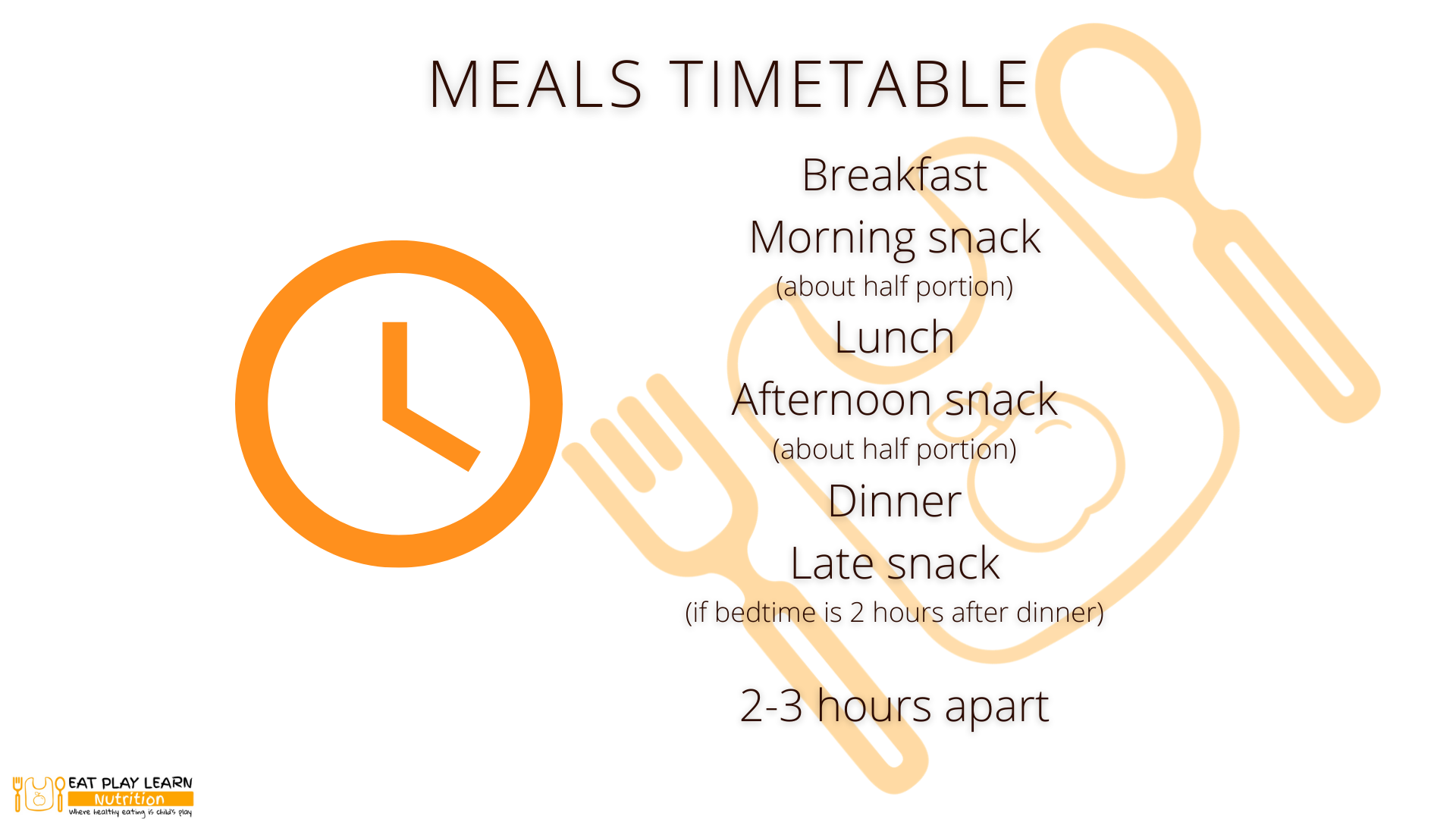
Depending on the times a child wakes up in the morning and goes to bed at night – how long their day is – they will have time to eat five to six meals throughout the day, every 2-3 hours.
The snacks they are supposed to have in between main meals are simply to keep them going, but they should not be big enough that the child isn’t hungry enough for the next main meal.
To finalise, I’d like to put it as simply as possible: snacks don’t have to come from a packet, they can be leftovers or a piece of fruit or a small tub of yoghurt or a few crackers with cheese. These are not dirty words, are they?
References
Are Packaged Toddler Foods and Milks Just Junk Food in Disguise? Jennifer McCann (IPAN) – article and presentation. https://blogs.deakin.edu.au/deakinnutrition/2021/01/14/are-packaged-toddler-foods-just-junk-food-in-disguise/
Food Standards Australia and New Zealand (FSANZ) https://www.foodstandards.gov.au/consumer/nutrition/Pages/Diet-quality-and-processed-foods.aspx#:~:text=Ultra%2Dprocessed%20foods%20are%20defined,further%20processing%20of%20food%20components