Dietary Requirements Responsibilities
I’m in the kitchen, covering for the chef – I’m their casual cook. I’m supposed to make a beef stroganoff for lunch. I’m also supposed to cook a dairy free version as well because one of the children attending that day is marked as “no milk” on the panel on the kitchen’s wall.
Thankfully, at this centre, there is no complete ban of dairy, but only a partial ban (e.g. in one room) on the days that an anaphylactic child attends. For this one, is not an anaphylaxis issue, so I can send the dairy free lot along with the dairy containing one.
So, I go on and make a traditional beef stroganoff and a small portion of a dairy free version, using coconut cream in replacement for dairy cream.
After lunch, the trolley comes back to the kitchen with the dairy free lot intact. I go over to the classroom to ask what happened and am told that the child liked the traditional one, with dairy cream. I must have given the educator a puzzled look because she went on explaining that he is supposed to “avoid milk to drink” and that “he might not even have an intolerance anymore”.
So, I requested the panel on the kitchen’s wall to be updated so I have the correct, and clearer, information in the future and don’t have to trouble myself, more than I must, to prepare allergen-free versions unnecessarily. Don’t worry, my request was very polite and immediately accepted as reasonable, AND immediately acted upon. 😊
Ok, that wasn’t a life-threatening situation, but is a real example of mismanagement of health-related dietary requirements when people aren’t on top of their responsibilities.
Keeping up-to-date information regarding children's allergies and intolerances is everyone's responsibility.
Every person in an ECEC service has a different job and will have different ways of exercising the responsibility of keeping a child's records up-to-date, but it is important that each one knows WHAT and WHEN to act.
The Australian Children’s Education & Care Quality Authority (ACECQA) offers guidelines for services to state in their food and nutrition policy – mandatory – the responsibilities of all people involved in the children’s diets.
I’ll list below the roles that are intimately linked to the health-related dietary requirements of each child – copied and pasted from ACECQA’s guidelines (reference below):
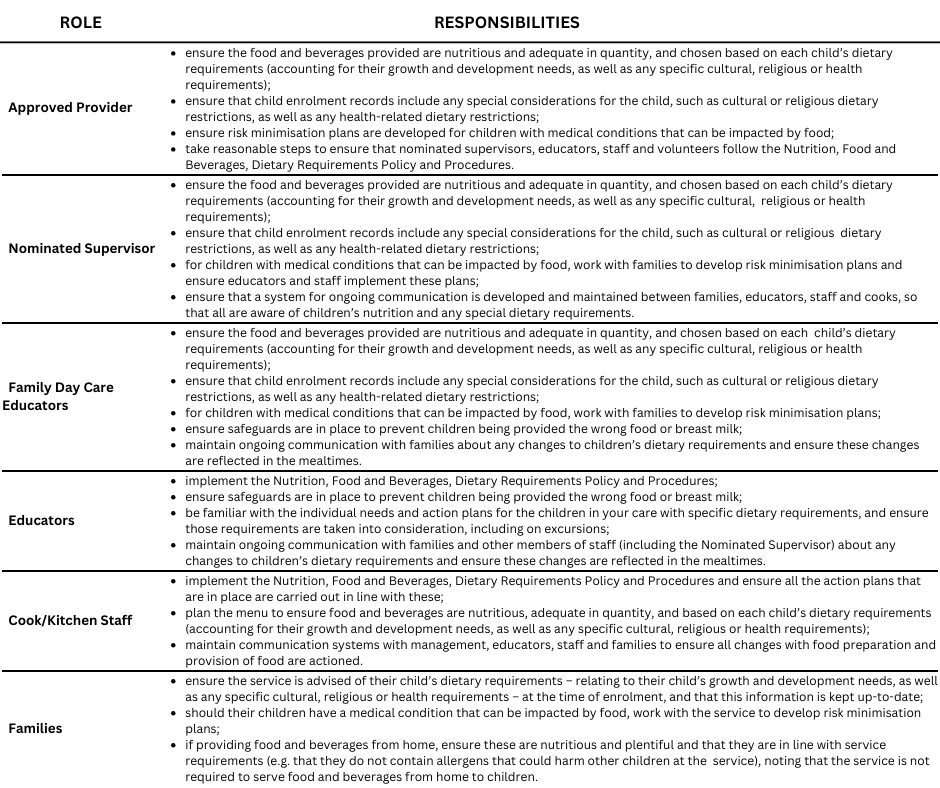
Extracted from ACECQA Nutrition, Food and Beverages, Dietary Requirements – Policy Guidelines
Summary
In general, a service’s management is responsible for (1) writing and implementing a food and nutrition policy, (2) asking the questions to collect from families accurate information about a child’s dietary specifics that may impact their health. I give here emphasis to the word “accurate” which may mean allergy/anaphylaxis plan and/or a letter from their health practitioner describing the condition, what is and what is not allowed and treatment, (3) sharing the information with the rest of the staff, and (4) keep information up-to-date.
Educators must (1) help management implement its food and nutrition policy, (2) be familiar with up-to-date information about each child’s specific dietary requirements, (3) communicate effectively with families and other staff members about any changes in a child’s requirements.
Cooks have to make sure they (1) plan menus that account for all dietary requirements and follow them, and (2) communicate effectively with management, other staff and families about any updates.
And the families are responsible for (1) provide accurate information about their child’s dietary requirements that may impact their health and keep it up-to-date, (2) work with the service management and staff to develop a system that minimises risks of accidental exposure, and (3) follow the service’s food and nutrition policy, including any food restriction to be brought from home to the centre.
You can see that everyone has a share in the responsibility of caring for the children’s food safety.
There are so many ways and procedures that a service can implement to become allergy aware and safe. I can’t cover it all in one article – neither am I qualified to do so 😉. But I would like to leave you today with my suggestion for a good start:
Have a robust food and nutrition policy. To write one, follow the guidelines ACECQA offers (follow link in the references). Then, make sure all your staff and families are aware of it – maybe collect their signatures to attest they have read it. Plan regular audits of it in the year and a review every few years.
Once you have the above in place, everyone can go back to the policy every time they are in doubt about a specific issue. It becomes a guide for all and helps to rule out misunderstandings and arguments and opinions.
I encourage discussions about it all during our workshops on managing allergies and intolerances in services. You can check more about them here.
reference
Australian Children’s Education & Care Quality Authority (ACECQA) - Nutrition, Food and Beverages, Dietary Requirements - Policy Guidelines (2021). Access it here.